LED Sections Work

Posted on   Leave a comment on LED Sections Work

Well that had its’ frustrating moments. Some of the wire contact pads tore out, so I had to solder in bypass wires. Then half way through I realized that I didn’t need a return line for power and ground from the tops, I could just home run all the power connections. So the wiring is a combination of daisy chain and home run. Only the data line is consistently daisy chained, as it must be to work, and to produce a fully sequential pattern.

Next I have to epoxy everything together and ensure that the top transition from copper to wood cap is watertight. Then these get put aside until the base is machined.

First LED section works

Posted on   Leave a comment on First LED section works

Soldering the wires onto the tiny contact patches on the ribbons turned out to be far less frustrating than other times I’ve done it. The key is to scrape all the silicone off the contact area with a machinist’s file until the copper is glossy, tin the pad, then apply the pre-tinned wire. It was trickier getting the shortest ribbon wrapped evenly around the shortest tube section. I also managed to reverse the ribbon sequence, from end to beginning, but as long as I’m consistent it’ll work.

There’s a blank area at the top of this one because of the pre-attached termination. Before I glue this piece together I’ll see about pushing the ribbon up a bit. I have a couple of days to think it through, since I’m otherwise busy Saturday.

I’ll also have to be very careful about colour coding of the wires. I used interconnect wires colours similar to the coding on the ribbon, which is White = Ground, Red/Yellow = Data, Black = VCC. That’s of course reverse of North American convention. The latter is used on the power supply. I just have to be careful and consistent.

Tops Epoxied

Posted on   Leave a comment on Tops Epoxied

I think I have the sequence of operations figured out. Today I epoxied the top caps in place and coated them with epoxy. For this I used System 5 epoxy, since a 5 minute setting time was fine. It just meant wasting quite a bit, with a separate batch for each cap. I didn’t have disposable brushes so I used the folded corner of a bit of paper towel. Half way though I though to heat the part after spreading the epoxy, thus lowering the viscosity and making for a smoother surface. You can see the epoxy coating on the caps by the gloss.

I also cut interconnect wires and removed the silicone coating from the ribbon section ends. Soldering wires onto the contact points is a finicky, frustrating operation which I will tackle tomorrow. If that goes well I will wrap the ribbons around the copper pipes. Then I’ll assemble the pipes into the tubes and epoxy the tops to make the copper/wood transition waterproof. I’ll tack the spiders in place but not glue them, so as to allow for thermal movement.

Tubes in Tubes

Posted on   Leave a comment on Tubes in Tubes

Using a crappy old pipe cutter is a good way of wasting expensive copper pipe. I found one in a box of plumbing supplies from my father. As long as I maintained significant sideways pressure during the first couple of rotations, it tracks true. Otherwise it travels a spiral. With only about 20cm of waste, I got the pipes I need. I’m guessing a bit on the exposed extension that will work, based on space available but with no idea about how I’ll run the pipes back to the manifold.

In any case, the pipes within pipes are ready for the LED ribbons, which I also cut to length. I purchased the waterproof ribbons this time, but they are stiffer due to the silicone coating and won’t conform to the copper pipes as well as the uncoated ones I’ve used in the past. I’ll think about it and have a go tomorrow.

New Spiders

Posted on   Leave a comment on New Spiders

I’m sure I’ll eventually find a use for the larger spiders. They might make nice wheels on a toy. The new ones fit the inside diameter perfectly. I had to sand the central holes a bit because apparently copper pipe isn’t exactly round.

The epoxy filled base delivery has been delayed a bit, so in the interim I’ll keep working on the pipes. I have the LED ribbon so tomorrow’s project will be to cut that into the 7 sections and start wrapping it around the pipes.

Light Tubes & Caps

Posted on   Leave a comment on Light Tubes & Caps

The base is with https://nine45.ca for filling with Epoxy. I should have it back in a few days. In the interim, I’ve been working on other projects from my list. The first was to build a set of “Kitchissippi” chairs. I had purchased the Eastern White Cedar late last year, and it’s been stickered and acclimating since then. I’m building 4 chairs for the shop, so it took a while to make all the parts. They are all ready for staining once I can do it outside.

The past couple of days I’ve been working ahead on the light and water-related parts of the fountain. I cut the Acrylic tubes to length, although the shortest one needs a bit of adjustment. Today I made the top caps and a set of spacing spiders for the bases. The top caps worked great, the spiders, not. The spiders are a perfect match for the OD of the tubes, not the ID. Oops! I’ll make another set tomorrow.

In the main photo you can see the other two projects I’m working on – the Kitchissippi chairs, and some parts for the “Nahrung” sculpture.

Birthday!

Posted on   Leave a comment on Birthday!
Lots of maple chunks
Wainlux laser engraver

Today is the anniversary of my 49th birthday. I spent it happily in the workshop. The Wainlux laser engraver I had supported on Kickstarter last summer arrived this morning. It’s been delayed for various reasons, not least because the developers overshot their Kickstarter goal by over 100x. After loading the driver and software I ran 3 tests. They all worked fine without issues.

The goal for the day had been to glue up the centre plug for the fountain base. That’s done too.

Base Partly Assembled

Posted on   Leave a comment on Base Partly Assembled
Wall segments assembled
Wall clamped
Wall glued and clamped
Base partly infilled

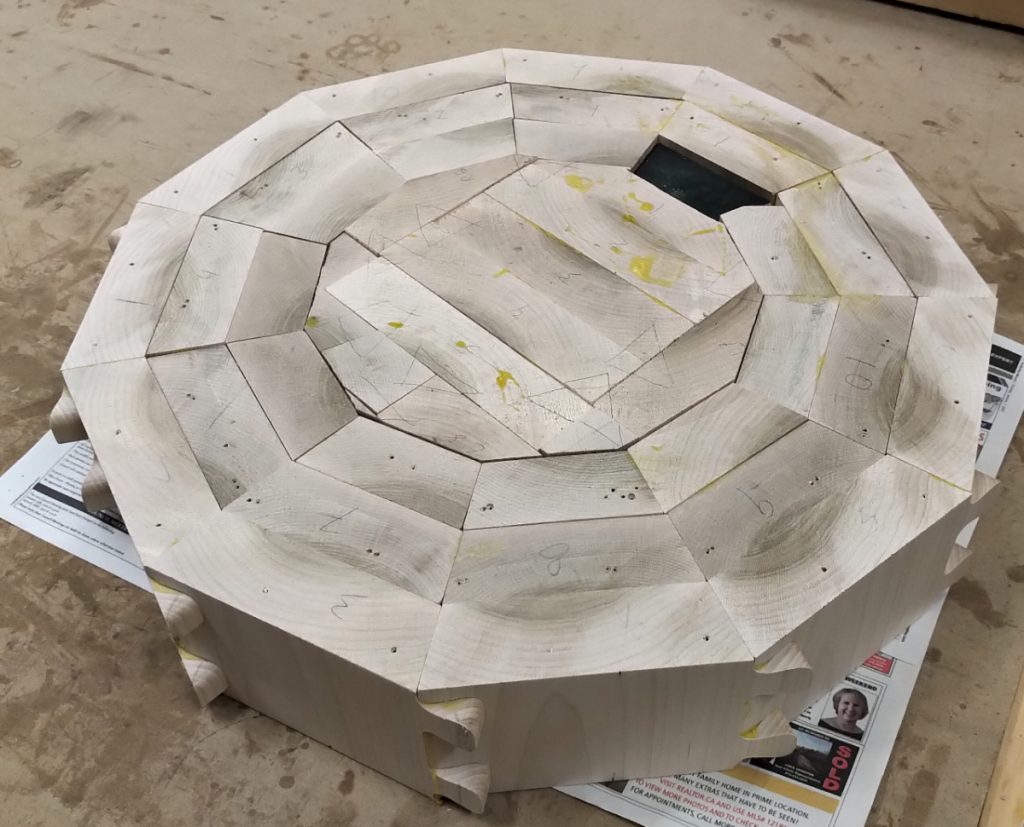
Today was productive – I got more done than anticipated. After lightly sanding the flash off the wall segments I did a trial assembly. The fit is quite loose, so assembly was no problem at all. Then I applied a strap clamp to judge the size and fit. It was fine. Diameter is now 565 mm, almost exactly what I had planned. Then I applied glue to the interfacing joints and clamped the assembly for several hours. While the glue was setting I realised that the first pass pieces could be trimmed to use as infill. I set my mitre saw to the correct angle and trimmed the tenons off. That left several extra pieces and the remaining short board. It was all just enough to do a second course of infill.

Now there’s just the 290 mm diameter centre which I will infill with the remaining second attempt board sections. They will be rectilinear, since radial pieces would get too small to machine safely.